

After spotting a Cape Weaver in Somerset West, I discovered why this colourful bird is famous for its intricate nests and remarkable breeding behaviour.
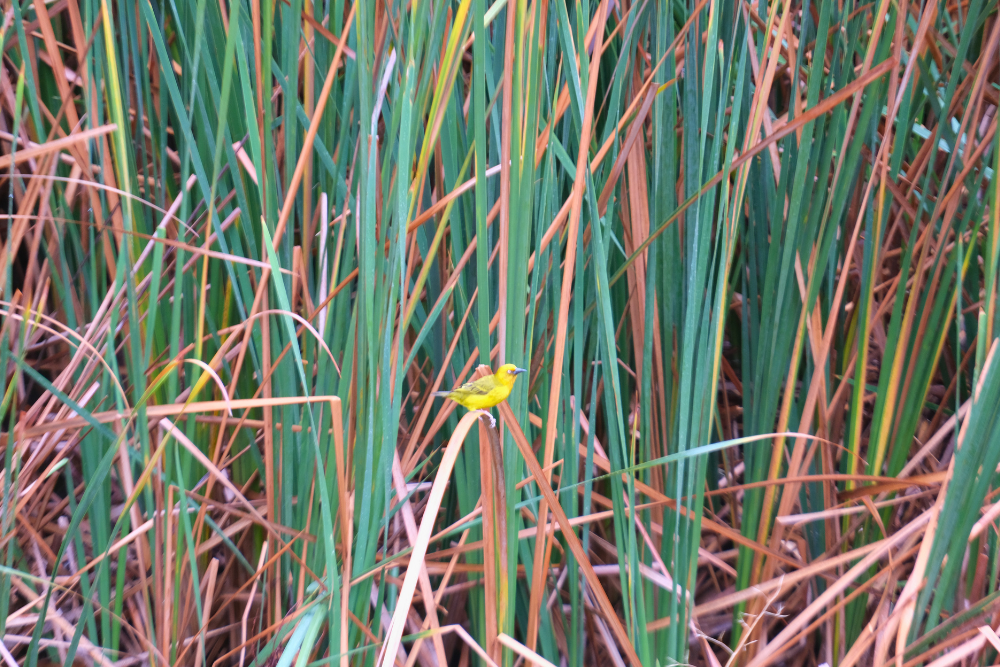
On a fresh Wednesday afternoon, 5 June 2024, just after the rain had cleared over Somerset West, I headed out for a quick walk around the lake. That’s when I spotted him—a small, brilliant flash of yellow darting through the greenery.
It was a Cape Weaver, chirping cheerfully as it hopped between the reeds before disappearing just as I tried to steady my phone for a quick video.
Moments like these remind me why the Helderberg feels so alive after rain. Curious to learn more, I headed home and googled everything I could about this little bird. What started as a simple sighting soon became a fascinating deep dive into one of South Africa’s most remarkable feathered residents.
How to Identify a Cape Weaver: Male vs Female
Once I knew what I was looking at, I couldn’t help but notice just how distinctive the Cape Weaver really is.
The Cape Weaver (Ploceus capensis), or Kaapse wewer in Afrikaans, is a small, stocky bird measuring around 17–18 cm in length. It’s one of those birds you’ve probably seen before without giving it much thought—especially if you spend time around gardens, parks, wetlands or anywhere there’s water nearby.
During the breeding season, the male Cape Weaver (mannetjie) is impossible to miss. His feathers become a brilliant golden yellow, with an orange-brown wash across his face, an olive-green back and one particularly eye-catching feature: a pale, almost white eye.
The female Cape Weaver (vroulike Kaapse wewer) is much more subtly coloured. She has olive-brown upperparts, buff-yellow underparts and a brown eye, while young birds closely resemble the females until they mature.
As I kept reading, I also discovered why Cape Weavers are so often confused with Southern Masked Weavers. They share many of the same habitats and are similar in size and colour, but the breeding male Cape Weaver’s pale eye is one of the easiest ways to tell them apart. It also has a slightly longer, more pointed bill.
The Song, the Dance and Those Incredible Nests
That lively chirping I heard was part of the unmistakable Cape Weaver call. Their sounds range from rapid chattering to harsh buzzing notes, becoming especially animated during the Cape Weaver breeding season, which generally peaks from spring into early summer.
But it’s their remarkable Cape Weaver nest building that really steals the show. This behaviour perfectly captures the cape weaver personality—busy, persistent, and full of character.
Male Cape Weavers are master builders, weaving intricate, kidney-shaped nests from long strips of grass and reeds. Rather than building just one, a determined male may construct several nests to impress prospective mates.
I wasn’t lucky enough to spot one of those incredible nests during my walk. The bird I saw stayed busy hopping between the reeds, and after the rain I wasn’t too keen to venture any closer to the water’s edge. The lake slopes down towards the reeds, and the ground looked far too wet and slippery to risk getting a better look.
If I’d been there during an active breeding colony, I might have witnessed the males hard at work, with females carefully inspecting each newly woven nest before choosing a mate. Each female tugs at the woven strands, testing the craftsmanship before deciding whether it meets her standards. If she approves, she’ll line the inside with softer material before laying her eggs. If not, the male simply gets back to work and starts weaving another.
Watching an active colony is like witnessing a tiny construction site, with birds constantly weaving, calling and flying back and forth.
Cape Weaver Habitat in South Africa
The natural Cape Weaver habitat includes wetlands, riverbanks, fynbos, grasslands, coastal thickets and farmlands, although these adaptable birds are just as comfortable in suburban neighbourhoods where there’s water nearby. Native to South Africa, Lesotho and Eswatini, they’re especially common throughout the Western Cape.
If you’re wondering where to see Cape Weavers, you don’t have to travel far. In Somerset West, they’re often spotted around lakes, wetlands and parks, particularly after rain when they’re actively feeding among the reeds and surrounding vegetation.
They’re also regular visitors to suburban gardens, so if you have trees, flowering plants or a water feature nearby, there’s a good chance a Cape Weaver in your garden will make an appearance sooner or later. Sometimes, the best birdwatching happens right outside your back door.
Fascinating Cape Weaver Facts
Perhaps the most surprising of all the Cape Weaver facts is that these birds are polygynous, territorial colonial nesters. A successful male may attract up to seven females during a single breeding season, defending his territory while continuously weaving new nests in an effort to impress potential mates.
Their diet is equally varied, consisting of insects, spiders, seeds, fruit and nectar, which is why they’re often seen moving between flowering plants, lawns and bird feeders.
A Little Wonder After the Rain
Sometimes all it takes is one unexpected encounter to make you appreciate the wildlife around you. What began as a quick walk after the rain turned into a memorable encounter with one of South Africa’s most charismatic little birds.
The next time you’re walking near a lake, wetland or even your own garden, keep an eye—and an ear—out for the unmistakable flash of yellow. You might just spot a hardworking Cape Weaver weaving its next masterpiece.













1 Comment